Stress is a type of fear. We tend to call fear stress when its directed at tasks that we are struggling with. We might also call this anxiety depending on our own associations/upbringing/certain nuances. Fear gets a bad rap. It’s not as fun to experience as excitement or joy, but it’s a necessary emotion that primarily exists to get us out of difficult or dangerous situations in one piece. It does a good job for the situations it was designed for: fighting off enemies or getting away. It does an okay job of helping us with more daily tasks; essays, paperwork, and meeting deadlines.
Here is an illustration of the Yerkes-Dodson Curve:
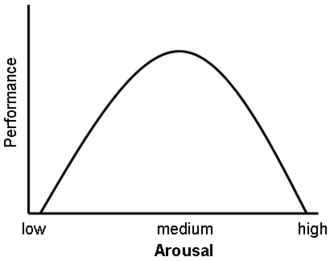
The Yerkes-Dodson Law states that there is an optimal level of arousal (one form of which is stress) that allows us to perform a task well. If there is not enough arousal we will be unable to focus on or begin tasks. If there is too much it becomes overwhelming which can make us forget things we know or make us feel stuck in a figurative or literal way.
Many of us have, occasionally, or frequently, maximized the use we get out of our stress response, by waiting till the last possible minute to start a task and meet the deadline. Starting a task at the top of the bell curve lets us use that rush of energy to do everything very fast, and experience a lot of anxiety for a short time rather than some anxiety for a very long time, which can be useful.
This will stop working if we do it too often. Everyone has a stress tolerance. Experiencing stress often raises that stress tolerance. This makes that productivity curve shift, so that the space between “optimal performance” and “paralyzing fear” gets smaller, and the space dedicated to apathy/disinterest grows bigger. Stress is a tool which is more effective the less we use it.
It will also stress us out more often. Intense fear responses are a fail safe our brains have for emergencies. When we invoke it, the emotional parts of our brains and the rest of our bodies think that we are in real immediate danger. When we invoke it often, our emotional brains begin to feel that we are in an unsafe environment, with lots of dangerous situations, and we have to be careful of danger around every corner. We will be irritable or jumpy so that we stay ready to fight potential threats. We will conserve energy for emergencies by avoiding more pleasant tasks, our bodies deeming those less necessary than dealing with the emergencies. We might start feeling as if we don’t belong where we live, or in our communities, to encourage us to leave and find a safer environment.
Fear is not the only motivating emotion. Desire is also motivating, as is anger, though we want to be careful with that one too.
One of the ways we use stress is by thinking about what will happen if we don’t do a task. We might instead use desire by thinking about what will happen after we complete a task. This can be difficult because sometimes it feels like the consequence of doing a task is that nothing will change. This isn’t completely true though.
Let’s work with an example. I am trying to do the dishes. There are a lot of reasons I don’t want to do the dishes. The dishes are gross, I don’t want to touch them, I don’t like being in the kitchen, I hate it when my hands are wet for an extended period of time, and it just won’t be fun. What will happen if I don’t do the dishes? We won’t have any pots and pans to cook with tomorrow, my roommate might get angry with me that the sink is full, and the dishes will be even harder to wash after they’ve sat with gunk on them overnight. These are things that I could think about if I wanted to motivate myself using stress.
What will happen if I do wash the dishes now? Well initially I will feel some gross things, my hands will get wet, and I will be bored. These are not motivating facts. I need to think ahead till after I have done them. AFter I have done the dishes the sink will be empty and easier to use, I will have clean dishes to eat and cook with, my roommate will be happy when they come home and see the clean sink, and I can go do something afterwards that I actually enjoy like playing a video game without worrying about the mess. I want those things and doing the dishes now is the fastest way to achieve that.
This applies to other things too. We will have a better time with exercise if we focus on wanting to be strong and fast than we will if we focus on a fear of being “out of shape”. We will have a better time with conversations if we focus on a desire to connect to others and build something stronger than if we focus on a fear of losing our relationships.
Stress and desire are both useful. It’s easy to do what we practice. If we’re used to using stress that will come more naturally, but if we practice chasing what we want it will become easier. This is something everyone is capable of doing on their own, but if this is something you struggle with it may be worth speaking to a therapist about.
Title image by Luis Villasmil on Unsplash